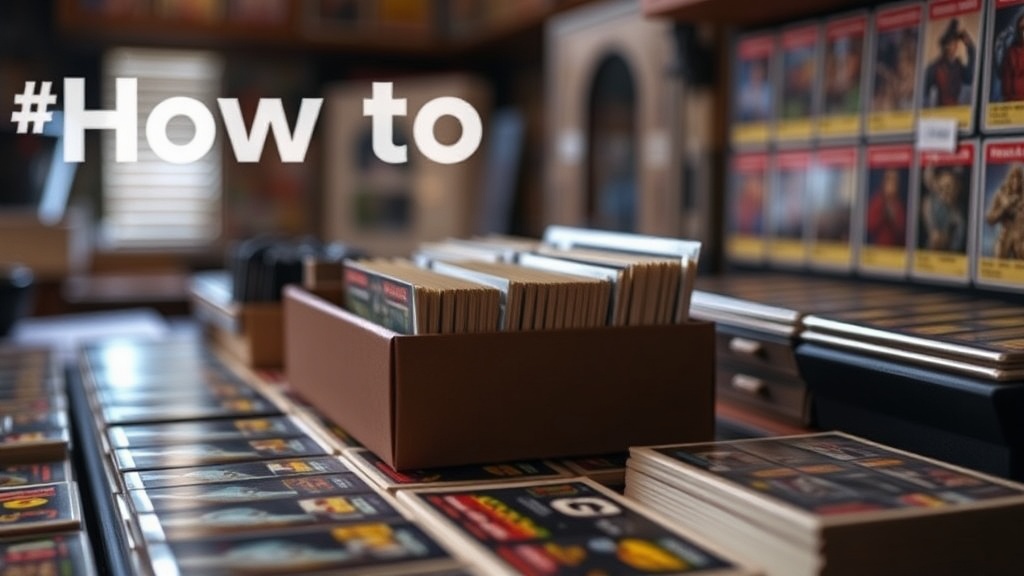
How to Store and Protect Your Trading Card Collection Long-Term

Trading cards — whether Pokémon, Magic: The Gathering, sports memorabilia, or vintage Magic sets — represent significant financial and sentimental investments. This guide covers every step of proper storage: sleeves, top loaders, binders, climate control, and insurance. By the end, you'll have a complete system for keeping cards pristine for decades (not just years).
What Supplies Do You Need to Protect Trading Cards?
You'll need four core items: penny sleeves, top loaders or card savers, storage boxes, and a climate-controlled environment. Skipping any of these creates vulnerability — moisture bends, light fades, and rough handling dings corners.
Let's break down each component properly.
Card Sleeves: The First Line of Defense
Penny sleeves — those thin, clear polyethylene pockets — cost roughly a penny each (hence the name). They're not glamorous. They don't "improve" your collection. What they do is create a barrier between your card's surface and everything else.
For standard trading cards measuring 2.5" × 3.5", Ultra-PRO penny sleeves remain the industry standard. BCW and Dragon Shield offer comparable alternatives. The catch? One size doesn't fit all. Japanese cards (slightly smaller at 2.25" × 3.125") need different sleeves. Oversized cards — like Topps Museum Collection relic cards — require 3" × 4" or larger options.
Here's the thing about penny sleeves: replace them periodically. They attract dust, they tear, and after a few years the plastic can yellow. Most collectors rotate sleeves every 3-5 years for high-value cards.
Top Loaders vs. Card Savers
After sleeving, rigid protection matters. You've got two main paths.
Top loaders — those rigid plastic shells — offer excellent corner protection. Ultra-PRO's 3" × 4" regular top loaders work for standard cards. For thicker relic or patch cards, you'll need 55pt, 75pt, 100pt, or even 180pt variants. (Card thickness is measured in "points" — one point equals 0.001 inch.)
Card Savers — semi-rigid sleeves made by Cardboard Gold — store flat and stack efficiently. PSA, BGS, and SGC actually prefer Card Savers for submissions. They're lighter, cheaper, and take up less space. That said, they offer less impact protection than top loaders.
| Feature | Top Loaders | Card Savers |
|---|---|---|
| Impact protection | Excellent | Moderate |
| Stacking efficiency | Bulky | Compact |
| Grading submission | Accepted | Preferred |
| Cost per unit | $0.08-$0.15 | $0.05-$0.10 |
| Best for | Display, high-value singles | Bulk storage, grading prep |
Worth noting: never slide cards directly into top loaders. Always sleeve first. Raw plastic can scratch surfaces. That $5 Luka Dončić rookie doesn't deserve micro-abrasions from trying to save a penny.
How Should You Store Cards Long-Term?
Store cards in a cool, dry place with stable temperature (65-70°F) and low humidity (30-50%). Avoid attics, basements, and direct sunlight. Use archival-quality boxes, and never stack heavy items on top of card storage.
Climate control sounds expensive. It doesn't have to be.
The Humidity Problem
Paper stock absorbs moisture. Absorbed moisture expands. Expanded cards warp, bend, and develop "soft corners" — death for grading prospects. Worse, humidity feeds mold. A single spore colony can destroy an entire collection.
Richmond, Virginia — where this advice originates — hits 80%+ humidity regularly. Collectors there use silica gel packets in every storage container. Replace or recharge them every 3-6 months. For serious collections, Eva-Dry renewable dehumidifiers work wonders in closets and storage rooms.
Monitor conditions with a basic hygrometer. Govee and ThermoPro make reliable units for under $15. Check readings weekly during seasonal transitions.
Temperature Swings Kill Collections
Attics hit 120°F in summer. Basements drop to 45°F in winter. These extremes cause expansion and contraction — the slow death of card integrity. Glue on jersey cards separates. Foils curl. Edges fray.
Ideal storage locations: interior closets, under-bed storage in climate-controlled rooms, or dedicated shelving away from exterior walls. If you must use a basement, invest in waterproof containers and improved shelving. Sterilite gasket boxes provide reasonable moisture barriers for under $20.
Lighting: The Silent Fader
UV light degrades printing inks. Display cases with UV-protective glass help. So does keeping cards in darkness 95% of the time. Those gorgeous display shelves you see on Instagram? They're beautiful — and potentially destructive if positioned near windows.
LED lighting produces minimal UV and generates less heat than incandescent or halogen. If you're building a display area, plan the lighting carefully.
Should You Get Your Cards Graded and Encapsulated?
Grading makes sense for valuable cards (typically $100+ market value), cards you plan to sell, or pieces requiring authentication. For personal collections of modest value, grading costs often exceed benefits.
Professional grading services — PSA, Beckett Grading Services (BGS), and SGC — encapsulate cards in tamper-evident cases. These cases provide excellent long-term protection. They also assign numerical grades affecting market value dramatically.
The Big Three Grading Companies
PSA (Professional Sports Authenticator) dominates sports cards and vintage Pokémon. Their 1-10 scale is industry standard. PSA 10 "Gem Mint" cards command massive premiums. Turnaround times vary wildly — expect 3-6 months for standard service, though they've improved since 2021's backlog disaster.
BGS uses a 1-10 scale with half-points and four sub-grades (centering, corners, edges, surface). Their "Black Label" 10 — perfect across all sub-grades — represents the holy grail for modern collectors. BGS cases feel more substantial than PSA's.
SGC — Sporting Goods Certification — uses a 1-10 scale with distinctive black-bordered "tuxedo" slabs. They're faster, cheaper, and increasingly respected. Many vintage collectors prefer SGC for pre-war cards.
Here's the thing: grading costs $15-300+ per card depending on service level and declared value. For a $25 rookie card? Not worth it. For a 1986 Fleer Michael Jordan rookie? Absolutely worth it.
When Grading Doesn't Make Sense
Personal collections — cards meant for viewing, not selling — often don't need grading. The $50-100 minimum (with shipping and insurance) buys a lot of other protection. That said, high-value ungraded cards sitting in binders represent risk. Consider at least storing raw valuables in Vault X binders or similar archival options.
Binder Storage: Yes or No?
Binders work for active collections, set building, and cards under $50 each. They don't work for long-term storage of high-value singles or as a primary protection method for graded cards.
D-ring binders with side-loading pockets prevent cards from slipping out. Ultra-PRO Platinum Series and Vault X Zippered Binders offer excellent protection. Avoid O-ring binders — they create pressure points that damage card edges.
Always use acid-free, PVC-free pages. Cheap vinyl pages release plasticizers that degrade card surfaces over decades. You'll spot PVC damage as a hazy film or stickiness — irreversible and devastating.
Store binders flat, never upright. Upright storage creates sagging pockets and card migration. Stack no more than 3-4 binders high. Heavy stacks compress lower binders, damaging contents.
Insurance and Documentation
Homeowners insurance typically covers collectibles — but only to $1,000-$2,500 without riders. A serious trading card collection needs scheduled personal property coverage or a standalone collectibles policy.
Companies like Collectibles Insurance Services specialize in this market. Policies cover theft, fire, water damage, and mysterious disappearance. Expect to pay roughly $0.50-$1.50 per $100 of coverage annually. A $50,000 collection runs $250-750 yearly.
Documentation matters for claims. Photograph everything. Maintain spreadsheets with card descriptions, condition notes, and current market values. Update annually. Store copies off-site or in cloud storage.
Inventory Systems That Actually Work
TCGplayer, Card Ladder, and My Collection from PSA offer digital tracking. Spreadsheets work fine too. The best system? The one you'll actually maintain.
Track: card name, set, year, condition, purchase date, purchase price, current estimated value, and storage location. The storage location field saves hours hunting for specific cards.
The Final Word on Long-Term Trading Card Storage
Protecting a trading card collection isn't complicated. Sleeve everything. Use rigid protection for valuables. Control temperature and humidity. Avoid light damage. Insure what you can't afford to lose. Document everything.
Whether you're holding a 1952 Mickey Mantle or a 2021 Topps Wander Franco rookie, the principles remain identical. Cards stored properly today retain value — and stories — for generations. Cards stored poorly become cautionary tales.
Start with your highest-value pieces. Work systematically. The peace of mind alone justifies the effort.
Steps
- 1
Choose the Right Card Sleeves and Protective Supplies
- 2
Organize and Store Cards in Binders or Storage Boxes
- 3
Control Temperature and Humidity for Long-Term Preservation